
Rotores de elutriación
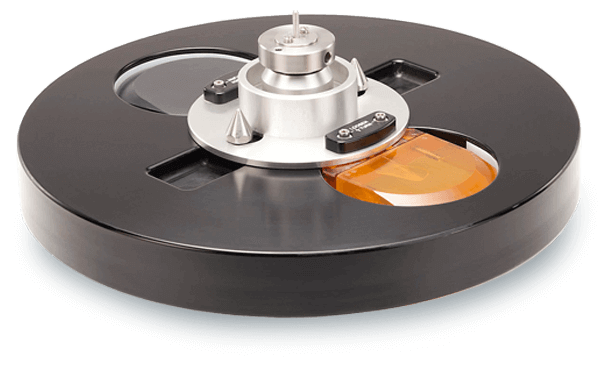
Un rotor de elutriación se ha diseñado para separar o concentrar suspensiones monodispersas de células o partículas simples (de un diámetro aproximado de 2 a 50 µm) según el tamaño. Un rotor de elución combina dos tecnologías de separación, por lo que sobre cada célula en la cámara actúan dos fuerzas opuestas:
- Fuerza centrífuga: Alejándola del eje de rotación. Este es el proceso de sedimentación bajo el influjo de un campo de fuerza centrífuga.
- Velocidad del líquido: Dirigiéndola hacia el eje de rotación, “elución en contraflujo”. Este es el proceso de separación mediante lavado.
La separación tiene lugar en una cámara de elución en forma de embudo. Mientras el rotor gira en la centrífuga, se bombea una suspensión de células a un caudal preestablecido desde fuera de la centrífuga en el rotor hacia el extremo estrecho de la cámara de elución. A medida que las células en suspensión se introducen en la cámara, se desplazan según su velocidad de sedimentación a las posiciones en el gradiente en las que los efectos que tienen ambas fuerzas sobre ellas se equilibran.
Las células pequeñas con velocidades de sedimentación bajas se lavan con rapidez hacia el eje de rotación. Estas células se lavan fuera de la cámara, hacia arriba a través del rotor, y hacia fuera hasta un recipiente de recogida. Las células algo más grandes o densas se desplazan atravesando la cámara con mayor lentitud y alcanzan un equilibrio en el límite de elución. Las células más grandes o más densas permanecen cerca de la entrada a la cámara donde la fuerza centrífuga y la velocidad del líquido son altas. Al aumentar el caudal paso a paso de forma gradual, fracciones sucesivas de células cada vez más grandes o densas pueden lavarse fuera del rotor y recogerse. El aumento constante del caudal en incrementos sucesivos elutriará finalmente todas las células de la cámara.
FAQ on Elutriation Rotors
How does an elutriation rotor work?
An elutriation rotor contains a specialized chamber in which cells are exposed to opposing centrifugal and fluid-flow forces. Smaller cells are carried out of the chamber more readily, while larger or denser cells remain until flow conditions change. This enables sequential collection of distinct cell populations.
What is counterflow centrifugal elutriation?
Counterflow centrifugal elutriation is a separation method in which fluid is pumped toward the center of a spinning rotor while centrifugal force drives particles outward. The balance between these opposing forces allows cells to be separated according to size and sedimentation behavior.
How are cells separated during centrifugal elutriation?
During centrifugal elutriation, cells are exposed to two opposing forces: centrifugal force, which drives cells away from the axis of rotation, and fluid flow, which pushes them in the opposite direction. Cells separate according to their size and sedimentation behavior. Smaller cells are elutriated first, while larger or denser cells remain in the chamber until higher flow rates are applied.
What is elutriation?
Elutriation is a separation technique that uses opposing fluid flow and centrifugal force to separate particles or cells according to their size and sedimentation properties. Unlike pelleting-based methods, elutriation enables continuous fractionation of cell populations while helping maintain cell viability.
What is centrifugal elutriation?
Centrifugal elutriation is a laboratory technique that combines centrifugation and controlled fluid flow within an elutriation chamber. Cells or particles separate based on their size and sedimentation rate as fluid moves against the centrifugal field.
What applications are elutriation rotors commonly used for?
Elutriation rotors are commonly used for cell fractionation, immune cell isolation, stem cell research, cell enrichment, cell therapy development, and other applications requiring gentle separation of viable cells.
What is the difference between elutriation and conventional centrifugation?
Conventional centrifugation typically separates particles by pelleting them within a tube. Elutriation separates cells continuously using opposing fluid flow and centrifugal force, enabling collection of distinct populations while minimizing cell stress and supporting higher cell viability.
What are the advantages of centrifugal elutriation?
Centrifugal elutriation can support gentle cell processing, high recovery rates, scalable workflows, and reproducible fractionation of cell populations. It is commonly used when viable cells must be isolated without labeling or extensive sample manipulation.
Why is elutriation used for cell separation?
Elutriation enables label-free separation of viable cells based on physical properties such as size and sedimentation rate. This makes it useful for applications where maintaining cell integrity and functionality is important.
