
Rotores de flujo continuo
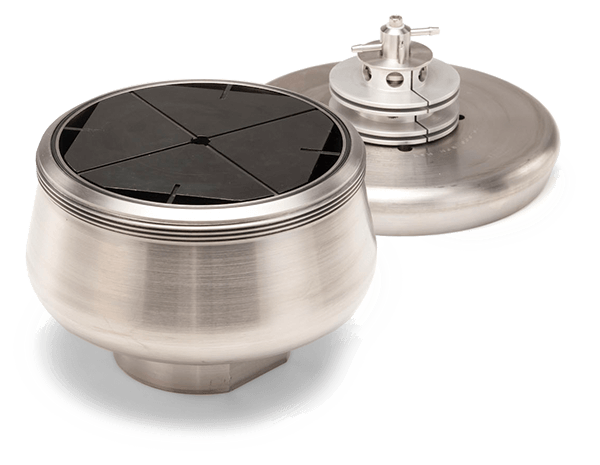
Un rotor de flujo continuo permite centrifugar grandes volúmenes de material a fuerzas centrífugas elevadas sin el tedio de llenar y decantar gran cantidad de tubos o tener que poner en marcha y detener el rotor con frecuencia. Al utilizar este rotor, o está recogiendo un sobrenadante o raspando un sedimento. Los rotores de flujo continuo minimizan de manera sustancial el tiempo de procesamiento del material por 2 motivos:
- Tienen recorridos cortos para reducir el tiempo total para la obtención de sedimentos compactos. Por tanto, obtienen sedimentos sólidos de manera eficiente de un flujo de muestras y facilitan un rápido flujo de material a través del rotor.
- Tienen grandes capacidades. Por lo tanto, no es necesario ponerlos en marcha y detenerlos con tanta frecuencia como los rotores convencionales. Esto permite ahorrar tiempo al reducir la manipulación de las muestras y el tiempo que se pierde en esperar a que el rotor acelere/decelere entre procesamientos.
Las principales aplicaciones para rotores de flujo continuo incluyen: grandes virus, mitocondrias, homogeneizados de tejido, bacterias, recolección de células y recolección de algas. Es mejor utilizar un rotor de flujo continuo si:
- El coeficiente de sedimentación de las partículas que se van a recoger es superior a 50 S. Debido a que el rotor tiene una elevada eficiencia de sedimentación, el material sólido se puede separar del medio líquido más rápido que con un rotor de cubo basculante o uno de ángulo fijo.
- La proporción sólido/líquido de la muestra es baja (5-15 %). Por encima de una proporción de sólido/líquido del 15 %, el rotor tiende a ser eficiente en exceso; es decir, sedimenta tan rápido que se llena de inmediato. Esto quiere decir que se debe detener para descargar los sedimentos compactos con tanta frecuencia que se pierde demasiado tiempo acelerando/decelerando el rotor y limpiando entre procesamientos. Por el contrario, si la muestra contiene poco material sólido, el rotor funcionará durante períodos de tiempo prolongados, procesando grandes volúmenes de material entre paradas.
FAQ Continuous Flow Centrifuge Rotors
What types of samples can be processed with continuous flow rotors?
Continuous flow rotors can be used for cell cultures, microbial suspensions, viral preparations, fermentation broths, tissue homogenates and other biological samples that require large-volume processing and particle recovery.
Why are continuous flow rotors used for large-scale centrifugation?
Continuous flow rotors help eliminate many of the inefficiencies associated with repeated batch processing. By allowing continuous sample loading and processing, they can significantly improve throughput when handling large sample volumes.
How does a continuous flow centrifuge work?
In a continuous flow centrifuge, the sample is continuously fed into the spinning rotor while clarified liquid exits the system. Particles with sufficient sedimentation properties are retained and concentrated within the rotor, allowing large sample volumes to be processed efficiently.
Why are continuous flow rotors advantageous for dilute samples?
Samples with low solid concentrations allow the rotor to operate for extended periods before unloading is required. This enables continuous processing of large volumes, making the workflow more efficient and reducing downtime.
When should a continuous flow rotor be used?
A continuous flow rotor is best suited for processing large sample volumes that contain relatively low concentrations of solid particles. It is particularly effective when the particles have a sedimentation coefficient greater than 50 S, allowing rapid and efficient separation.
What happens if the solid concentration exceeds 15%?
When the solid-to-liquid ratio is above 15%, pellet formation can occur too quickly, causing the rotor to fill rapidly. This requires frequent stops for pellet removal and cleaning, reducing overall process efficiency due to repeated acceleration and deceleration cycles.
What are the advantages of continuous flow centrifugation?
Continuous flow centrifugation can reduce sample handling, improve throughput, minimize downtime between runs and support efficient processing of large-volume samples. These advantages make continuous flow rotors valuable for scale-up and production-oriented centrifugation workflows.
What is the difference between a continuous flow rotor and a standard centrifuge rotor?
Standard centrifuge rotors process samples in discrete batches using individual tubes or bottles. Continuous flow rotors allow material to be processed continuously while the rotor remains in operation, making them better suited for large-scale centrifugation and high-throughput workflows.
Why is a continuous flow rotor recommended for particles with a sedimentation coefficient above 50 S?
Continuous flow rotors have very high pelleting efficiency. For particles with sedimentation coefficients greater than 50 S, they can separate solids from liquids more quickly than fixed-angle or swinging-bucket rotors, improving throughput and reducing processing time.
What is a continuous flow rotor?
A continuous flow rotor is a centrifuge rotor that allows samples to be continuously introduced and processed while the rotor remains in operation. This design enables efficient processing of large sample volumes without the need for repeated centrifuge tube loading and unloading.
What applications are continuous flow rotors commonly used for?
Continuous flow rotors are commonly used for large-scale cell harvesting, bacterial and yeast culture processing, virus purification, cell culture clarification, and concentration of biological particles from large liquid volumes.
What is the ideal solid-to-liquid ratio for a continuous flow rotor?
A continuous flow rotor performs best when the sample contains approximately 5% to 15% solids. Within this range, the rotor can process large volumes efficiently without requiring frequent interruptions.
